Calibration gets you sharp. A Kit Health Check keeps you there.
Every few months, or monthly for the best results, calibrate and then run FoCal’s other tests while you’re set up. FoCal keeps every result and shows how each camera and lens is holding up.
Your kit changes so gradually you don’t notice.
You’ve put a lot into your cameras and lenses. They get knocked, drift and wear, and it usually happens gradually, so you don’t notice until a shoot comes back soft.
Once you’re set up to calibrate, the rest of the check is the same setup: autofocus consistency, sharpness across the apertures, stabilisation and sensor dust.
FoCal tracks every result. Kit Status and Maintenance Watch show what needs attention, and the Analysis trends pick up gradual decline or sudden changes in how your kit performs.
The routine
- Target Setup
- Fully Auto calibration · you’re set up, so it’s worth it
- AF Consistency
- Aperture Sharpness · or MultiTest
- Stabilisation Test · for stabilised lenses or bodies
- Dust Analysis · one run per camera body, not per lens
Six tests, one setup.
A Kit Health Check is a routine: the tests FoCal already has, run while everything is set up for calibration.
1. Target Setup
Checks position, distance, light and settings, so every result after it can be trusted.
2. Fully Auto calibration
Once you’re set up, it’s worth calibrating: CalCheck isn’t much quicker and tells you much less. Each result shows whether the adjustment is drifting.
The Fully Auto calibration guide3. AF Consistency
Focuses again and again and shows how repeatable it is. A decline can point to wear in the focus drive.
The AF Consistency guide4. Aperture Sharpness (or MultiTest)
Finds the sharpest aperture and how much softer it gets wide open or stopped down. MultiTest covers calibration and sharpness in one longer run.
The Aperture Sharpness guide5. Stabilisation Test
For stabilised lenses or bodies: how much the stabilisation really helps when you’re holding the camera.
The Stabilisation Test guide6. Dust Analysis
Once per camera body: where the dust is, which apertures it shows at, and how much it’s likely to affect your pictures.
The Dust Analysis guide
Calibrate between checks, too, after a hard knock, servicing or a big change in temperature, and before an important shoot.
CalCheck is the quick check for in between, for example before a shoot when there’s no time to set up for everything. It isn’t part of the routine.
What FoCal does with your results.
The History tools use the results you’ve already collected, so there’s nothing extra to do. The more you test, the more FoCal can tell you.
Kit Status
Every camera and lens pairing at a glance: when it was last tested and calibrated, and whether anything needs attention. By camera, by lens, or one at a time. Zoom lenses are tracked separately at their wide and tele ends.
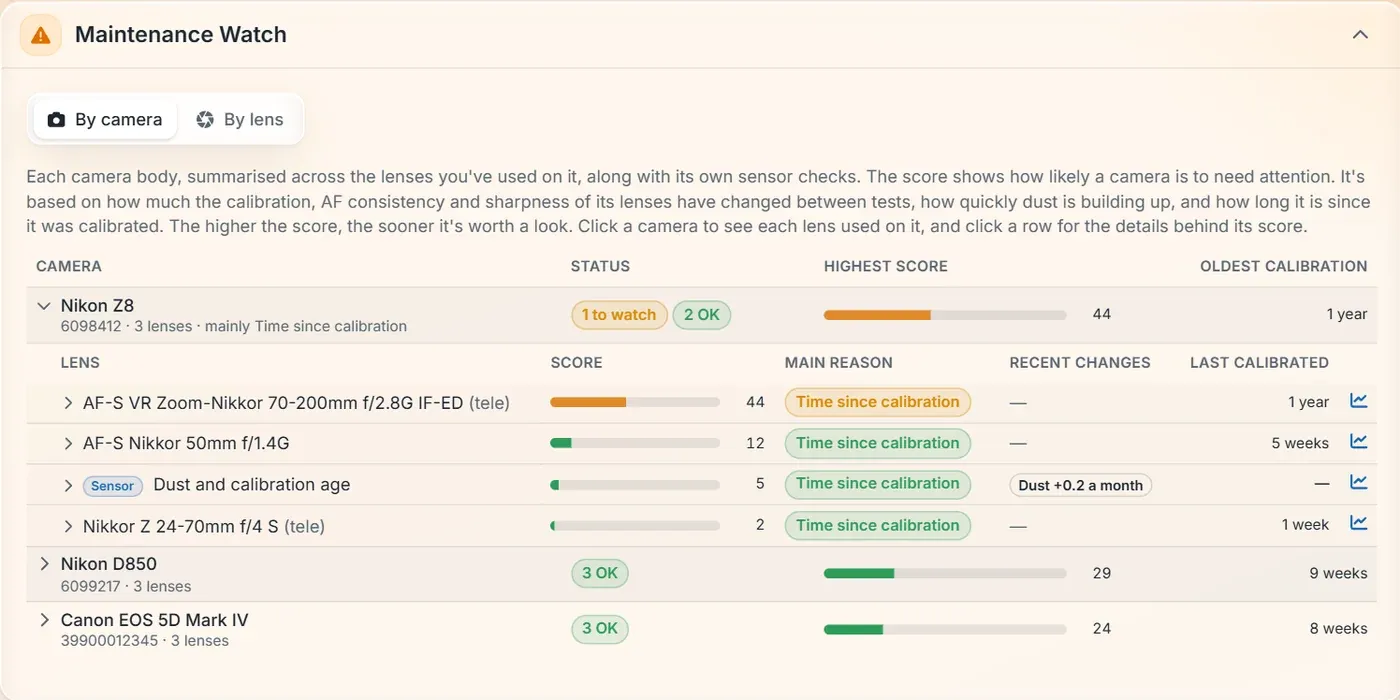
Maintenance Watch
Highlights pairings that are drifting, becoming less consistent, losing sharpness or overdue for calibration. The Kit Insights panel on FoCal’s Home page sums up what needs your attention.
Analysis
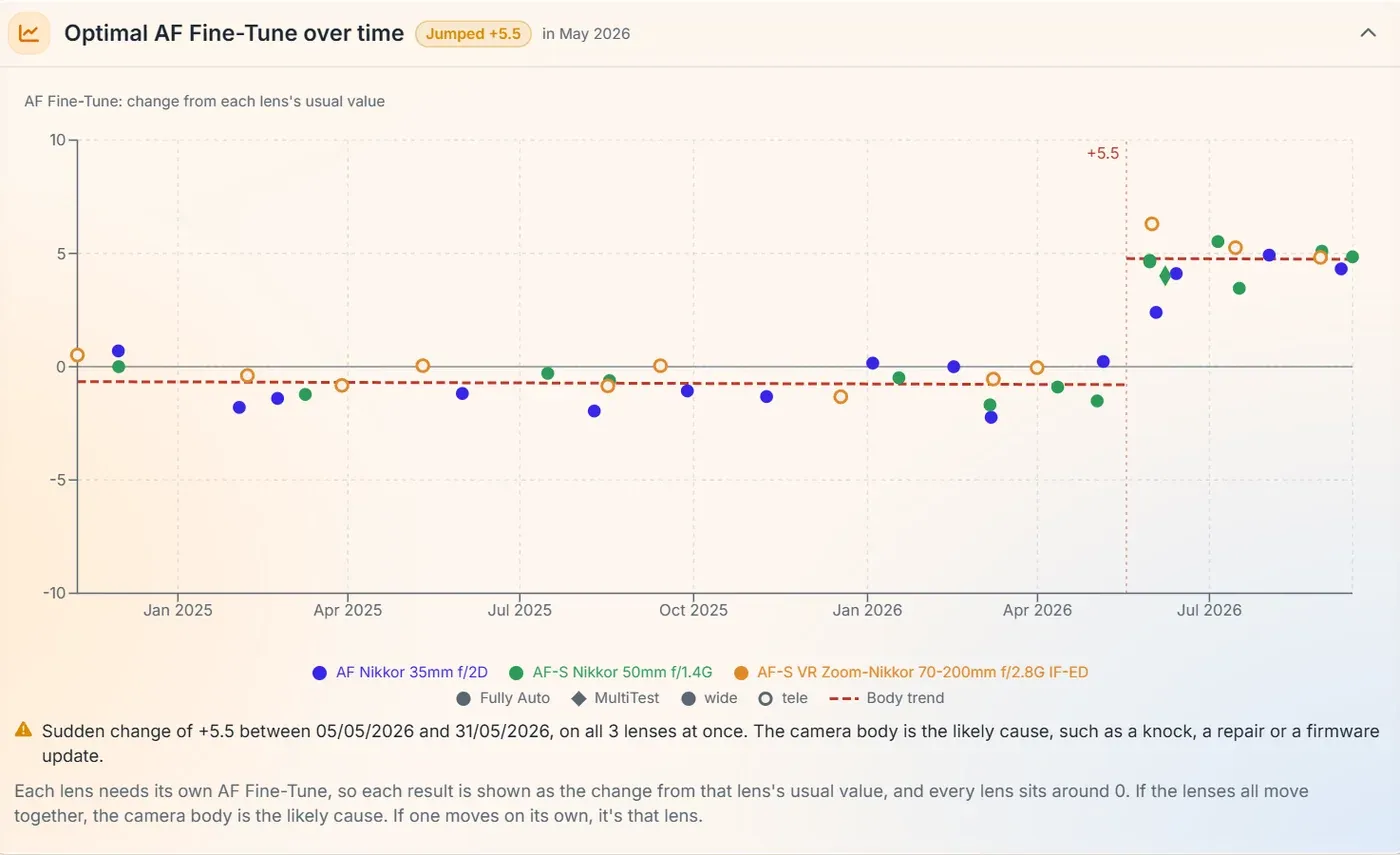
Analyse a camera, a lens, a camera and lens pairing, or your whole set of bodies:
- AF Fine-Tune drift over time, with a note on any significant jumps
- Sharpness over time, and sharpness against aperture: the sweet spot and where diffraction takes over
- AF consistency, dust, stabilisation and CalCheck results over time
- Lens Personality and Camera Personality charts, explained in plain English
- Camera bias, and a grid of every lens against every body
- PDF reports for a camera, a lens or a pairing
Compare
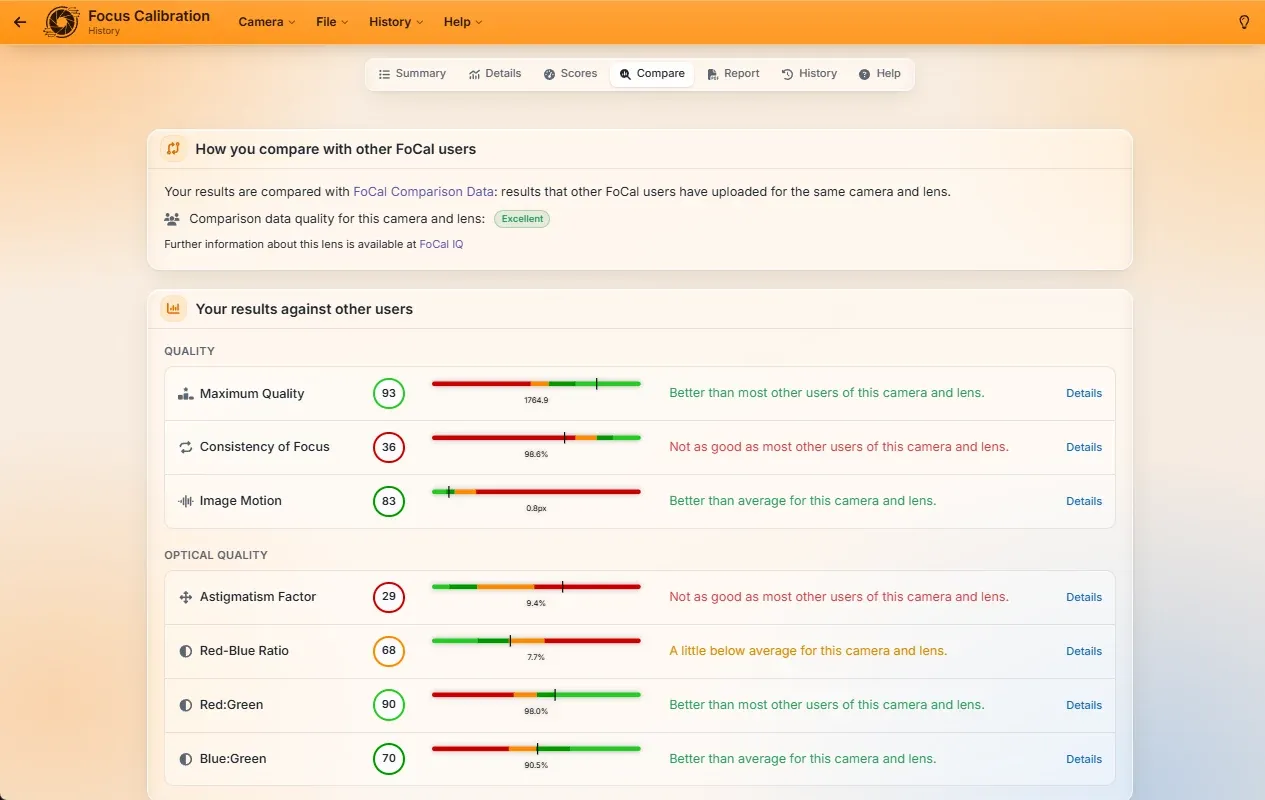
Each result can be compared, score by score, with other FoCal users of the same camera and lens, so you know whether a number is normal for that kit.
The full check needs FoCal Pro.
The tests after calibration, and the History, trends and comparisons that make the check worthwhile, are in FoCal Pro and FoCal Commercial.
FoCal Plus
- Target Setup
- Fully Auto calibration
- Calibration Check
- Not included: AF Consistency, Aperture Sharpness, MultiTest, Stabilisation and Dust
- Not included: History, Kit Status, Maintenance Watch and Analysis
Plus gets you sharp. To see how your kit is holding up over time, upgrade to FoCal Pro.
FoCal Pro
Kit Health Check- Everything in FoCal Plus
- Every test in the routine
- History, Kit Status, Maintenance Watch and Analysis
- The Compare tab, while support is active
Everything you need for a Kit Health Check.
Start your first Kit Health Check.
FoCal Pro has every test in the routine, and tracks the results for you.