By “AF processor” I mean a block of functionality, not necessarily a chip: it might be a dedicated chip or an algorithm running on another processor in the camera.
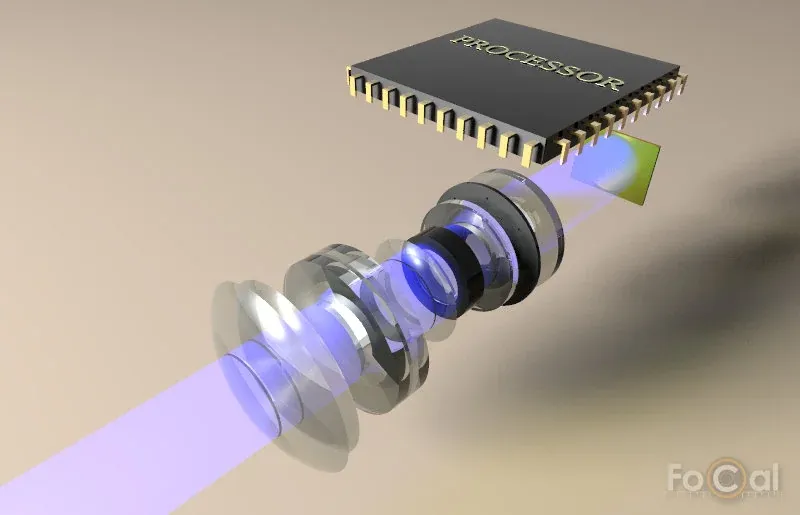
It takes in what the AF sensor and the lens tell it, and tells the lens which way to move its focus group, and how far. We’ve seen that the AF sensor’s measurements aren’t perfect, the lens’s information isn’t always accurate, and the lens can’t always be moved precisely. Here’s how those little imperfections add up to a soft shot.
Open loop or closed loop?
The first question is whether autofocus checks its work. That’s down to the algorithm in the AF processor.
Open loop: take one measurement from the AF sensor (with phase detect, that’s both a direction and an amount) and move the lens to match. One measurement, one move.
- Measure focusOne reading
- Move the lensOne move
- Take the picture
Closed loop: the same, plus one vital step. Once the lens has moved, take another reading to check it’s in the right place, and go round again if it isn’t.
- Measure focus
- Move the lens
- Measure again: in focus?If not, go back and move again
- Take the picture
Repeat until the AF sensor says it’s in focus
Open loop focusing would explain a lot: take a slightly wrong reading, move a slightly imperfect lens, and assume all is well. There’s your soft picture! But cameras can check their result, so it makes sense for them to use closed loop focusing when they can. And in most situations, that’s what they do.
All the time in the world
So how many times should the camera go round the loop? “Until it’s in focus” sounds right, and for single-shot autofocus (AF-S) it is.
But what if you want the shot now? And what if the AF sensor never quite says it’s in focus?
When time runs short
The big advantage of open loop focusing is speed. Camera makers won’t say much about how their autofocus works, but careful testing shows a few situations where cameras skip the checks.
Quick shooting
Open loop focusing has been shown to be used when:
- the subject is (reported to be) only a little out of focus, and
- you press the shutter button all the way in one go.
That makes sense: a full press with no pause for focus confirmation says you want the picture right now, and if the subject is only slightly out of focus, one small move should do it.
Continuous autofocus
At high frame rates in continuous AF there’s little time to measure, move and check. It’s probably not truly open loop, but with so few checks, everything rests on how accurately the camera senses focus and moves the lens.
Take an extreme example: the Z9 can shoot with full autofocus at 120 frames a second. That leaves 8.3 milliseconds between frames to measure, calculate and move the focus.
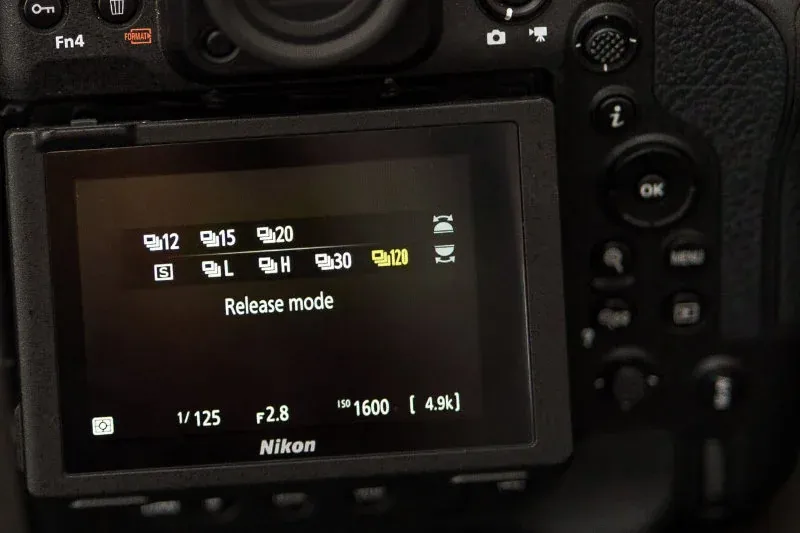
The electronics are impressively fast, but moving lumps of glass still means accelerating, decelerating and taking up backlash, and 8 milliseconds isn’t long. Every check halves the time: measure, move and check once, and you have about 4 milliseconds for each step. Now try it with an older F-mount lens and its less precise motor.
Your settings
Many cameras let you favour taking the picture over getting focus. The more you lean towards release, the fewer checks the camera is likely to make. Here are two of those settings on the Z9:
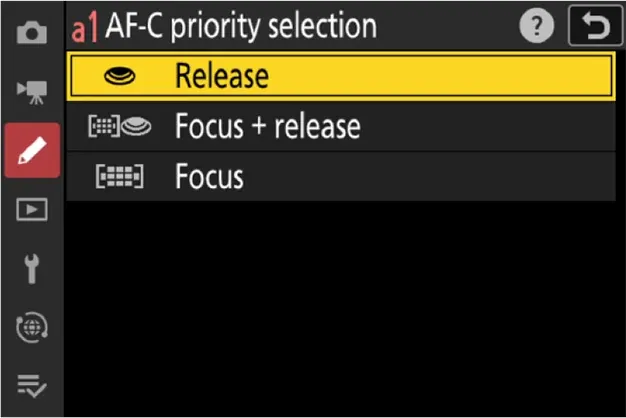
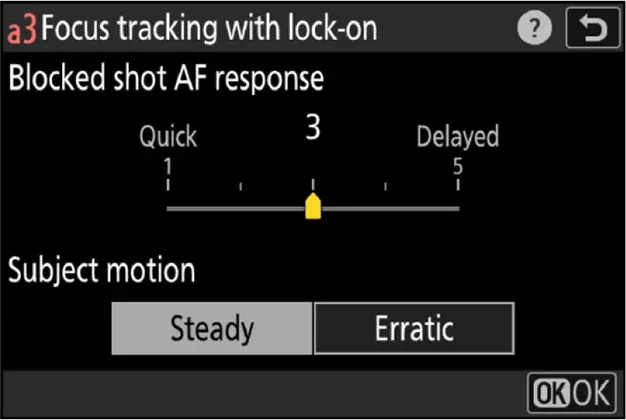
Putting it all together
The AF sensor and the lens optics
We’ve seen things that change the AF sensor’s measurement: mask placement errors, microlens imperfections and problems with the lens optics. Some, like a lens element out of place, shift the measurement right across the sensor. The sensor then reports a different amount of defocus from a perfect one: “24 to the left” instead of “26 to the left”.
In the open loop or time-limited cases, with one measurement and one move, that error goes straight into where the lens ends up.
When time is short, or you’ve set the camera to favour speed, errors in the AF sensor or the lens optics go straight into the focus.
But in closed loop focusing that doesn’t matter, does it? The camera keeps measuring and moving until it’s in focus.
Unfortunately some of these problems, like mask errors or a tilted or decentred element, affect the measurement differently at different points on the sensor. Mask errors might affect the left- and right-masked pixels differently, for instance. Then the sensor can report the subject as in focus when it’s actually slightly, and always, out of focus.
Errors in the AF sensor or the light path can make an out-of-focus subject read as in focus, in the same way every time.
Help me out here, lens!
Suppose the AF sensor is perfect and reports exactly “26 to the left”. The AF processor still has to turn that into a lens movement, and for that it uses the correction data in the lens, which allows for the zoom setting, the lens design and the quirks of that particular lens, measured in the factory.
Think about that. Your lens is a few years old. It’s your favourite, and it’s been used a lot. It’s a zoom, so you’ve racked it in and out countless times, and every shot has moved the focus group back and forth along its guides. Do you really expect the calibration data inside it still to describe it as it was in the factory?
The lens mechanics
Add worn mechanical parts and slight shifts in the mount and the optics, and the instructions sent to the lens can easily be a little wrong.
When there’s no time to check, the focus ends up slightly off, and the picture is softer than it should be. When there is time to check, a few things can happen:
- the lens lands in the wrong place, the check spots it, and it moves again: slower focusing, which matters more the faster you need it,
- in bad cases every move overshoots, and the lens hunts back and forth without ever settling,
- depending on the algorithm, the final position may be within the camera’s limits but always slightly to one side of perfect focus.
That last one is a fixed offset: the perfect case for a small AF Fine-Tune adjustment.
Wear and optical changes make the lens’s own calibration data inaccurate, and that causes focus errors.
So, does it really happen?
This guide has set out the ways a mirrorless camera can still need its focus tuning:
- errors in the on-sensor phase detect measurement,
- optical, mechanical and correction data problems in the lens,
- trade-offs in the AF processor (this chapter).
Next: the evidence that they really do add up to a need for calibration.