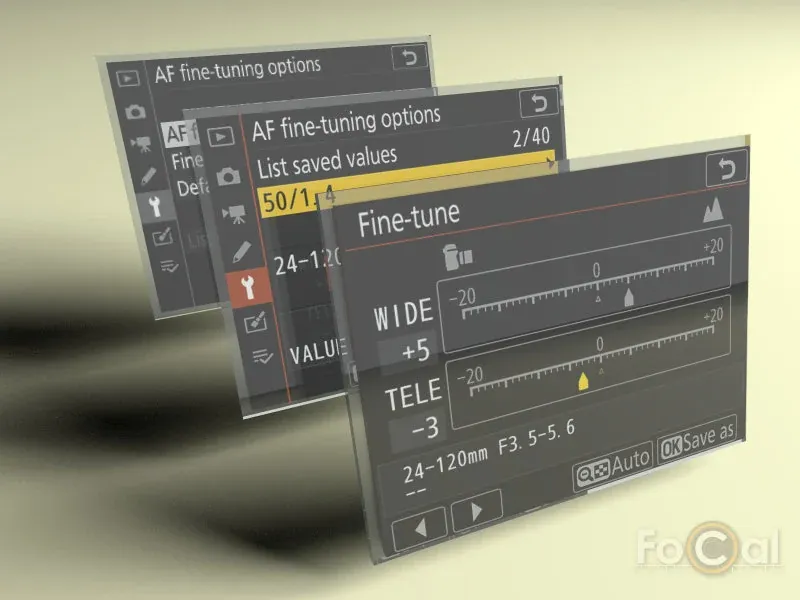
When I sat down to write a quick explanation of why mirrorless cameras might still need calibrating, it got out of hand. I dug through patents, snippets from camera makers and obscure corners of the web, and reverse-engineered lens protocols. I modelled sensor parts and lenses in a ray-tracer I hadn’t used for nearly 30 years, adding deliberate defects to see what they do to autofocus. And I wrote, deleted and rewrote an awful lot of words.
Yes, I’m biased: FoCal is calibration software. So rather than hand-waving, I wanted to show the why: the many small things that can add up to noticeably soft pictures, even on a mirrorless camera, and that a small focus adjustment fixes.
“If you want to understand something, teach it.”
The spoiler
Here’s what FoCal users’ results from Nikon Z cameras say, alongside Nikon DSLRs for comparison:
| 1+ | 2+ | 3+ | 4+ | 5+ | |
|---|---|---|---|---|---|
| Nikon DSLRs | 95% | 86% | 77% | 68% | 60% |
| Nikon Z, F-mount lenses on the FTZ adapter | 80% | 46% | 22% | 10% | 5% |
| Nikon Z, native Z-mount lenses | 62% | 17% | 5% | 2% | 1% |
Source: FoCal IQ, averaged over 24 Nikon DSLRs and 12 Nikon Z cameras.
Mirrorless cameras need much less adjustment than DSLRs. Getting rid of the separate AF sensor really was a good idea. But look at the F-mount lenses on the FTZ adapter:
- almost 5 in 10 would be noticeably sharper after calibration (2 units or more),
- about 8 in 10 would get some improvement.
Even with native Z lenses, 17% needed a noticeable adjustment. And even 1 unit is worth having: it can make autofocus faster, which makes it more accurate when you push it, tracking fast subjects or in low light.
Phase detect and contrast detect
Cameras use two kinds of autofocus.
Contrast detect is what you’d do by hand: turn the focus ring, see if it gets sharper, carry on until it’s just past its best, then come back. It uses the same sensor that takes the picture.
Phase detect looks at the light from two different angles, and from one measurement works out both how far out of focus the subject is and in which direction. In a DSLR it’s done by a separate AF sensor. In mirrorless cameras, which nearly all use it now, it’s done by special pixels on the image sensor itself.
Phase detect is fast, but it isn’t infallible, and it causes more focus problems than contrast detect. So that’s what this guide is about.
Mirrorless vs DSLR
The argument for not calibrating goes like this: a mirrorless camera has no separate AF sensor. It measures focus with the same sensor that takes the picture.
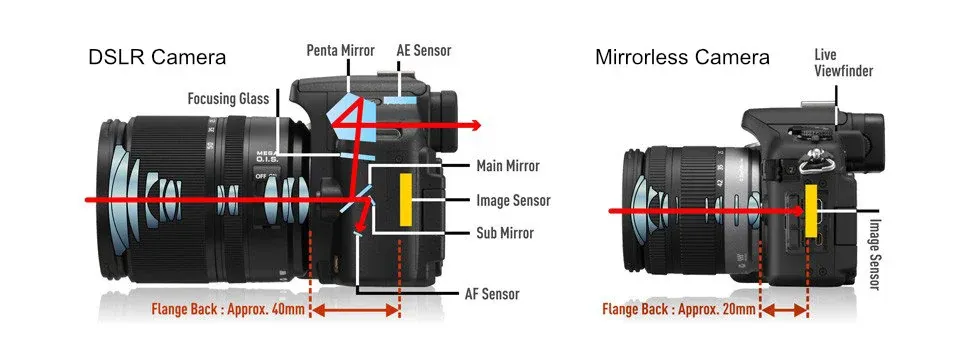
That’s fundamentally different from a DSLR, as the DSLR guide explains. The biggest reason a DSLR needs calibrating is the physical gap between its AF sensor and its image sensor: the AF sensor can think the picture is in focus when it isn’t quite, at the image sensor. Take away the separate AF sensor, the argument goes, and the problem goes too.
It mostly does. But not completely, as the chart shows.
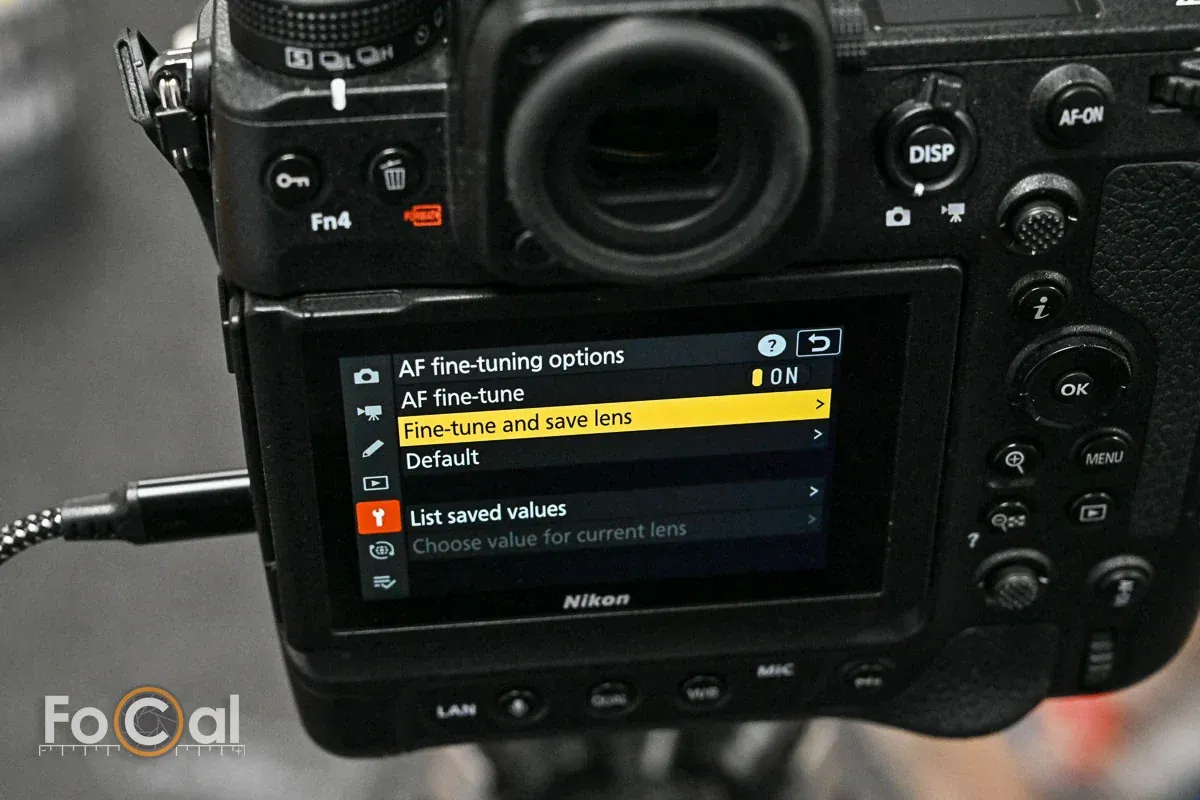
I’ll concentrate on Nikon Z cameras, because they have AF Fine-Tune and FoCal supports all 14 of them, so we have plenty of data.
So why does it still need it?
Here are the reasons, each with its own chapter. Don’t worry if they don’t mean much yet:
- the masks on the phase-detect pixels being a fraction out of place, or the wrong size,
- microlenses out of place or the wrong shape.
- the light path tilted by the mount, a mount adapter, decentred or tilted elements, or the stabiliser,
- how precisely the lens can be moved, and wear on its motor and mechanics,
- out-of-date or missing calibration data inside the lens.
- how the autofocus is programmed to trade accuracy for speed,
- your own settings.
First, though, how on-sensor phase detect works.
Which mirrorless cameras can be adjusted?
- Nikon Z: every model has AF Fine-Tune, and FoCal calibrates all 14.
- Olympus: the E-M1 and E-M1 Mark II can be adjusted for every focus point. FoCal calibrates them in File Mode.
- Panasonic: the Lumix S5 II, which brought phase detect to the S range, has focus micro adjustment.
Canon, Sony and Fujifilm mirrorless cameras have no focus adjustment for you to set. If one does need adjusting, it has to go to a service centre. FoCal can still check the focus on the Canon EOS R, EOS RP, EOS R5 and EOS R6, so you know whether it needs that trip.
The autofocus system
A last bit of groundwork. People talk about the autofocus sensor, but it’s only one part of the whole autofocus system, which is split between the camera and the lens:
In the camera
- AF sensor: measures how far out of focus the subject is, and which way.
- AF processor: takes what the AF sensor and the lens tell it, and tells the lens where to move. The autofocus algorithm lives here.
In the lens
- Optics: the glass you, and the camera, look through.
- Mechanics: motors, gears, rails: anything that moves.
- Calibration data: corrections programmed into the lens in the factory.
Taking away the separate AF sensor removed the biggest cause of focus errors, not all of them. The rest are in the sensor, the lens and the AF processor.