Astigmatism Factor – MultiTest
(See Chart Features for general chart features - changing scales, copying to clipboard etc)
What this shows
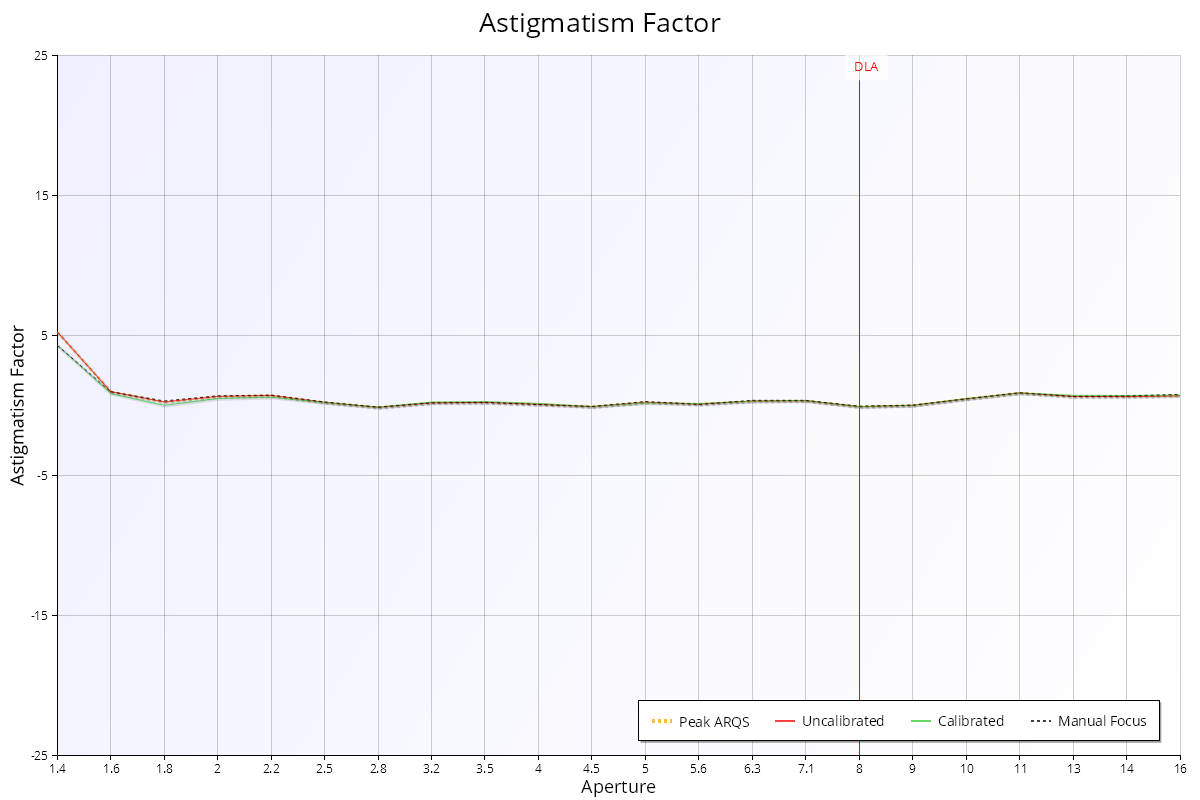
The Astigmatism Factor chart compares the sharpness measured in the horizontal and vertical directions at each aperture. A well aligned lens is about equally sharp in both directions.
How to read it
- X axis: aperture, from wide open on the left.
- Y axis: Astigmatism Factor, from -25% to +25%. 0% means horizontal and vertical sharpness are the same. Above 0%, the horizontal direction is sharper. Below 0%, the vertical direction is sharper.
- Red line ("Uncalibrated"): Astigmatism Factor with the focus adjustment at 0. In Live View mode this line is called "Wide Open" (focused wide open, then stopped down).
- Green line ("Calibrated"): Astigmatism Factor with the lens calibrated for best focus wide open.
- Orange dashed line ("Peak ARQS"): Astigmatism Factor at the focus adjustment with the best average quality across all apertures (see Aperture Range Quality Score (ARQS) – MultiTest).
- Black dashed line ("Manual Focus"): Astigmatism Factor when focused perfectly at each aperture.
- "DLA" marker: the diffraction limited aperture for this camera.
The Calibrated and Peak ARQS lines are only shown when the test uses camera focus adjustment.
What good looks like
The lines stay close to 0% across the aperture range. Some increase wide open is normal, especially for fast lenses, and usually improves as you stop down. As a guide, values within about 5% of zero are good.
If it looks wrong
- A sudden spike at one or two apertures: this usually means vibration or movement during those shots. Check the tripod, the floor and anything that could shake the camera, then run the test again.
- Values well away from 0% at every aperture, test after test: the lens may have a decentred or misaligned element. Check real-world sharpness, and consider the manufacturer's service centre if it repeats.